What are the best practices for tree felling?
Tree felling requires great care. At Arboriste Expert Conseil, we ensure that we follow the most stringent standards in effect and the safest tree-felling techniques for trees, our workers and your property. The use of best practices is our priority to provide you with outstanding customer service. For the sake of transparency, we present some of these techniques.
Directional felling techniques
Directional felling is a technique that ensures that a tree falls in a planned direction. After delimiting and preparing his felling area, the arborist analyses the tree and its environment according to 5 criteria:
- Detection of potential sources of danger;
- Identification of elements that can influence the direction of the tree's fall (wind, snow, weight distribution of the crown, curvature of the tree, etc.);
- The planning of safe retirement paths;
- The determination of the thickness of the hinge which must correspond to one-tenth of the diameter of the tree;
- The establishment of a felling plan taking into account the analysis carried out.
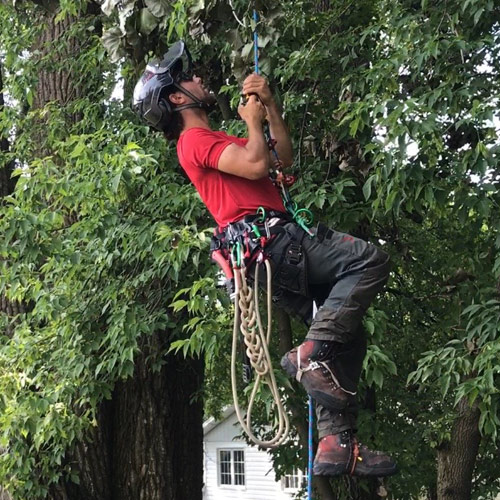
In urban areas, this technique is used only if the ground space is large enough. Otherwise, felling by dismantling will be given priority. This technique uses a system of ropes and pulleys to control the fall of branches and tree sections.
Slashing of the felled tree
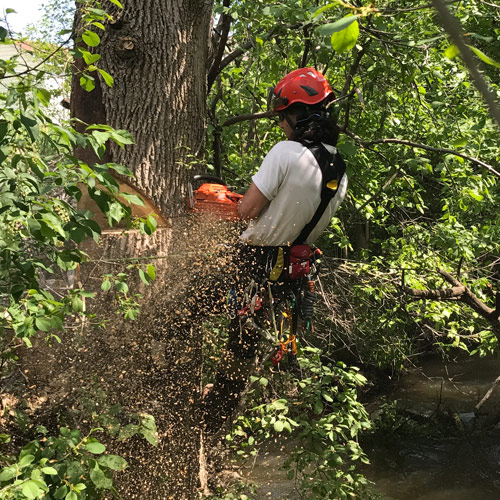
Once cut down, the tree must be sawn with a chainsaw. This step and the use of this tool requires the adoption of a working method that considerably reduces the risks to everyone's safety. It is particularly important for the arborist to be aware of the points of tension and compression on the tree's wood, because these points can present a risk of the saw bouncing back.
Felling operations require the expertise of professionals to be carried out safely and in compliance with current standards and municipal regulations. Contact our team of arborists today!
For your peace of mind and your safety
Contact Arborist Experts